RADIO
RADIO






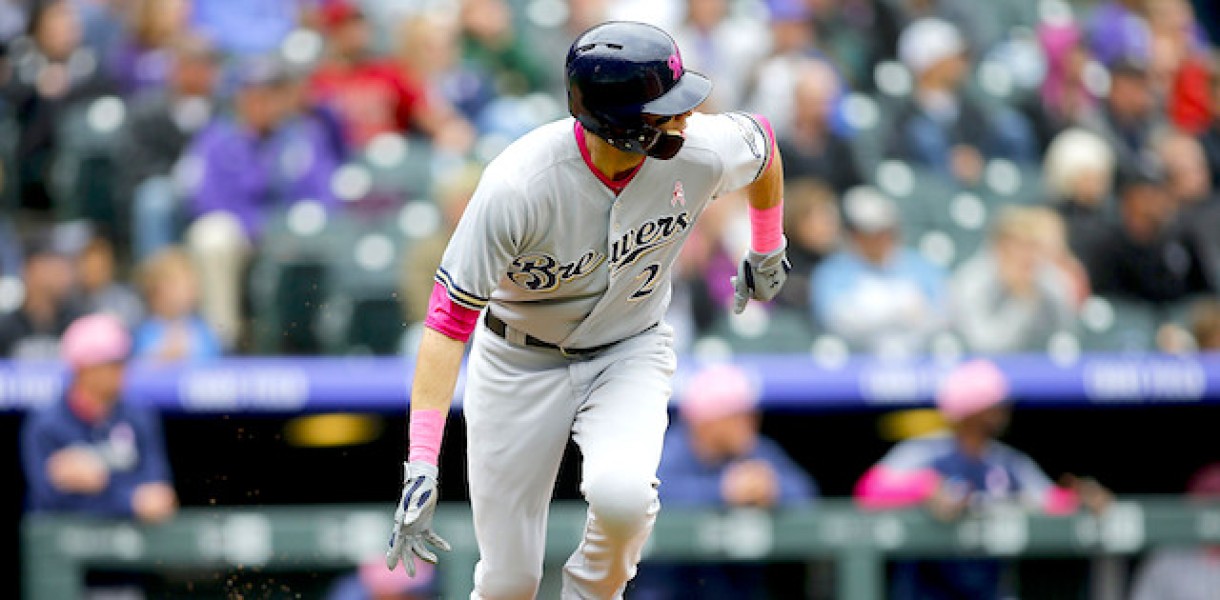
Milwaukee Brewers outfielder Christian Yelich was among the worst hitters in K% in the 2020 MLB season and struggled offensively, especially for fantasy baseball. Matt Goodwin digs into his Statcast profile to figure out why.
As we discussed in Part 1 focusing on Ketel Marte, it can sometimes be tough to know which way to go with it. There are the very basic stats: batting average, runs batted in, home runs, and maybe on-base percentage, but we know they are not always the most useful in player analyses even if they are still the categories upon which your league determines wins and losses.
We can look at things like K% and BB% to get a better idea of how the player arrives at a particular batting average or RBI total. However, what we really want to know is how good the player is at being a hitter, not necessarily how well the results pan out despite fantasy being a results-driven endeavor. To know how those results are achieved and why it matters, you have to dig into the metrics that measure the underlying talent over which the player has more direct control.
This series will start with the leaderboards for a given mid-level stat (K%, BB%, ISO, OBP, SLG, and OPS), identify a player or two of intrigue, and take a deeper dive into the underlying skills driving that particular stat using only publicly available data from Fangraphs and Baseball Savant.
Featured Promo: Save 50% off the regular price with discount code CHAMP, for a limited time. Exclusive access to our Team Sync platform, DFS cheat sheets, Lineup Optimizers, betting/prop picks, and exclusive content from Nick Mariano and Eric Cross! GAIN ACCESS NOW
Digging In On Christian Yelich
Christian Yelich is an absolute stud. Why, then, did he have such a terrible 2020?
Obviously, we are starting here with his K% which increased around 50% from 2019 going from 20.3 to 30.8, the latter putting him in the 11th percentile in all of Major League Baseball among qualifiers. It might be tempting to simply look at this and think that we have found the problem: in a weird, short, small-sample size season Yelich at an outlier strikeout rate which will regress to the mean and he will be fine in 2021. Sure, maybe.
This is the thing about this kind of information in a vacuum: it can be used to confirm a bias on either side. You could say, it was a weird year with only 60 games, there was no real spring training and things just didn’t click in a season that a lot of players really didn’t care all that much about.
We could both cite this abrupt and significant increase in strikeouts to make our individual arguments. What does that mean? It means we need more relevant information. For additional context, he also went from hitting .329 to .205 and while the strikeouts explain some of it, there has to be more to the story, right?
Remember that batting average is an output number, but it is not entirely useless. Let’s quickly look at batted ball data for balls in play, thus eliminating the Ks from the equation and what we can glean from his batting average on balls in play (BABIP) which eliminates strikeouts and home runs to get a better picture of the quality of the contact.
In 2019, Yelich posted a BABIP of .355 and in 2020 it was .259. The latter is evidence that when he didn’t strikeout, he was getting better results than his overall average would suggest, but the strikeouts do count so to have been equally as productive as he was in 2019, the BABIP would have needed to be higher than .355, not 100 points lower. This all suggests that while the strikeouts were a problem, they were not the whole story. Here is one final piece of evidence to support that: his expected batting average in 2020 was just .250 and while that is a good bit higher than his real number which offers some hope, it put him in the 48th percentile which is below average for a player who was clearly a first-round pick in 2020 and, for many, the first overall. Not great.
If quality contact on balls that were not home runs, it would be good to look at some swing and contact information that might be helpful. Here are five stats to consider: O-Swing%, Z-Swing%, O-Contact%, Z-Contact%, and Contact%. Here is what each means: the percentage of the time a hitter swings at a ball outside of the strike zone (O-Swing%), the percentage of the time a hitter swings at a ball inside the strike zone (Z-Swing%), the percentage that a batter makes contact on swings outside of the strike zone (O-Contact%), the number of times a batter makes contact on swings inside of the strike zone (Z-Contact%), and the number of times a batter makes contact when he swings regardless of the location of the pitch (Contact%).

Yelich swung a lot less frequently in 2020 and made less contact on those swings. He also had a lower swinging-strike rate (11.5% to 10.9%). So he swung less often overall, missed more on swings he took both inside and outside the strike zone, but still lowered his swinging strike rate? Huh? This must mean that he took a lot of strikes. Here’s a chart that shows Yelich’s called strikes, total strikes, and called strike percentage over the last three years:

From 2019 to 2020 that is a nearly 13% increase in called strikes. As we discovered with Ketel Marte, called strikes create counts in which the pitcher has a significant advantage in the outcome based on eventual wOBA, so let’s take a look at that family of stats next. Here are his weighted on-base numbers from the previous three years:
These tell us two things: 1) the strikeouts are not the whole story because the results of contact are also way down in terms of quality of how he actually got on base as well as with the expected outcomes of contact, and 2) there could easily be a correlation between his increase in called strikes and the diminished quality of the outcomes of his overall at-bats. The xwOBA (88th percentile) and xwOBAcon do provide glimmers of hope for 2021, but there has to be some sort of adjustment in order to capitalize on the true potential.
Still Hitting Hard?
Next, I’d like to explore his HardHit% as a means of looking at input stats to see if, perhaps, the reason for worse outcomes is weaker contact. However, you don’t have to look too far down the savant page to see that his HardHit% was in the 98th percentile at a whopping 55.6, the highest of his career by about 5% and about 7% higher than 2019. When he hit the ball, he still hit it hard. So what gives? Well, you can hit the ball hard, but it doesn’t mean it works out. This is where it is vital to see where the ball went after he smoked it and to do that, we should take a look at GB% and FB%.
In 2019, Yelich hit the ball on the ground 43.2% of the time which is high, but not insurmountable. In 2020, that number rose to 50.8% which put him at the 20th highest percentage in the league. That means that a good chunk of those hard-hit balls likely went straight into the ground. Conversely, his FB% went from 35.9 to 29.8 while his line drive rate stayed pretty flat. This means he was turning hard-hit fly balls into hard-hit ground balls which is the opposite of what you want to try to do.
This absolutely helps to explain, combined with the significant increase in strikeouts, why Yelich struggled so much and his Barrel% went from being 97th percentile in 2019 to 80th percentile in 2020 (from 15.8% to 12.1%). Not that an 80th percentile Barrel% is bad in a vacuum, but it is a huge dropoff from having been elite the year before.
We know this: Yelich struck out far too much last year and way more than he ever had before. He swung less, took more called strikes, hit the ball hard more frequently when he did make contact but put way too many of them on the ground instead of in the air.
Conclusion
When looking at Ketel Marte, the conclusion was that he needed to swing more, particularly at the first pitch, to better control the count. The same can be said for Yelich, but on all pitches throughout the count. He was taking too many strikes, putting himself into pitcher’s counts too often, and making less contact as a result. Even when he was able to hit the ball hard, which was on more than half of his contact, he traded fly balls for ground balls which can be partially explained by giving the pitcher the count advantage.
Yelich doesn’t need to swing harder, he needs to swing more, especially at balls in the strike zone. When he did that in 2019, he produced a wRC+ of 174 which is why we all drafted him in the top-three in 2020 fantasy drafts. Last year, that dipped to 112 which, admittedly, feels generous. ATC has him pegged in 2021 for just 142. Personally, I think that is a hedge and he will either be 160+ or 110- with an 80%/20% chance of the former over the latter. It will hinge entirely on swinging at more on pitches in the zone to minimize strikeouts and turning those ground balls back into fly balls.
If anybody can make that adjustment, it’s Christian Yelich. Take the chance on drafting him at what will most likely be a huge discount for the production you get, but do be aware of what awaits if he cannot.
The next installment of the series will turn to BB% and examine two new players from those leaderboards.
Download Our Free News & Alerts Mobile App
Like what you see? Download our updated fantasy baseball app for iPhone and Android with 24x7 player news, injury alerts, sleepers, prospects & more. All free!