RADIO
RADIO







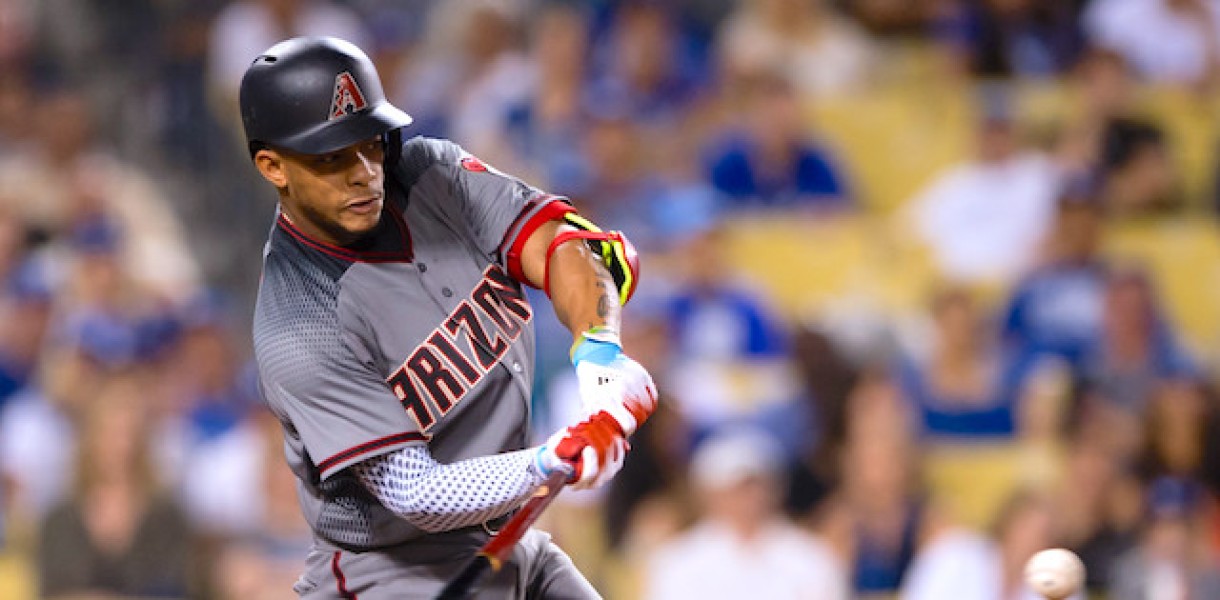
Arizona Diamondbacks second baseman (2B) Ketel Marte was among the leaders in K% in the 2020 MLB season but still struggled offensively, especially for fantasy baseball. Matt Goodwin digs into his Statcast profile to figure out why.
There are so many metrics that exist to evaluate player performance, it can sometimes be tough to know which way to go with it. There are the very basic stats we all grew up with: batting average, runs batted in, home runs, and maybe on-base percentage. We also know that they are not the most useful in player analyses even if they are still the categories upon which your league determines wins and losses.
If we go a little deeper, we can look at things like K% and BB% to get a better idea of how the player arrives at a particular batting average or RBI total. However, what we really want to know is how good the player is at being a hitter, not necessarily how well the results pan out. Yes, fantasy is a results-driven endeavor, but if you want to know how those results are achieved and why it matters, you have to dig into the metrics that measure the underlying discrete skills.
This series will start with the leaderboards for a given mid-level stat (K%, BB%, ISO, OBP, SLG, OPS, and wOBA), identify a player or two of intrigue, and take a deeper dive into the underlying skills driving that particular stat using only publicly available data from Fangraphs and Baseball Savant.
Featured Promo: Save 50% off the regular price with discount code CHAMP, for a limited time. Exclusive access to our Team Sync platform, DFS cheat sheets, Lineup Optimizers, betting/prop picks, and exclusive content from Nick Mariano and Eric Cross! GAIN ACCESS NOW
Strikeout Percentage
You don’t need me (or anyone else) to tell you that, on their own, strikeouts are not a productive outcome nor a desirable skill in a hitter. We do not seek players who strike out at high rates. However, we might be able to excuse a high strikeout rate under certain circumstances, especially if the approach causing them is the same approach leading to outcomes we do desire.
In roto or categories leagues, strikeouts themselves do not hurt you, but the negative impact on things like batting average, OBP or OPS might. In points leagues, not only do you suffer the opportunity cost of a lost at-bat but often-times you are punished as well. It is always important to note your league settings for context before coming to a misleading conclusion. Let’s start with a quick look at Fangraphs leaderboards for the league’s top 20 and bottom 20 in K%:
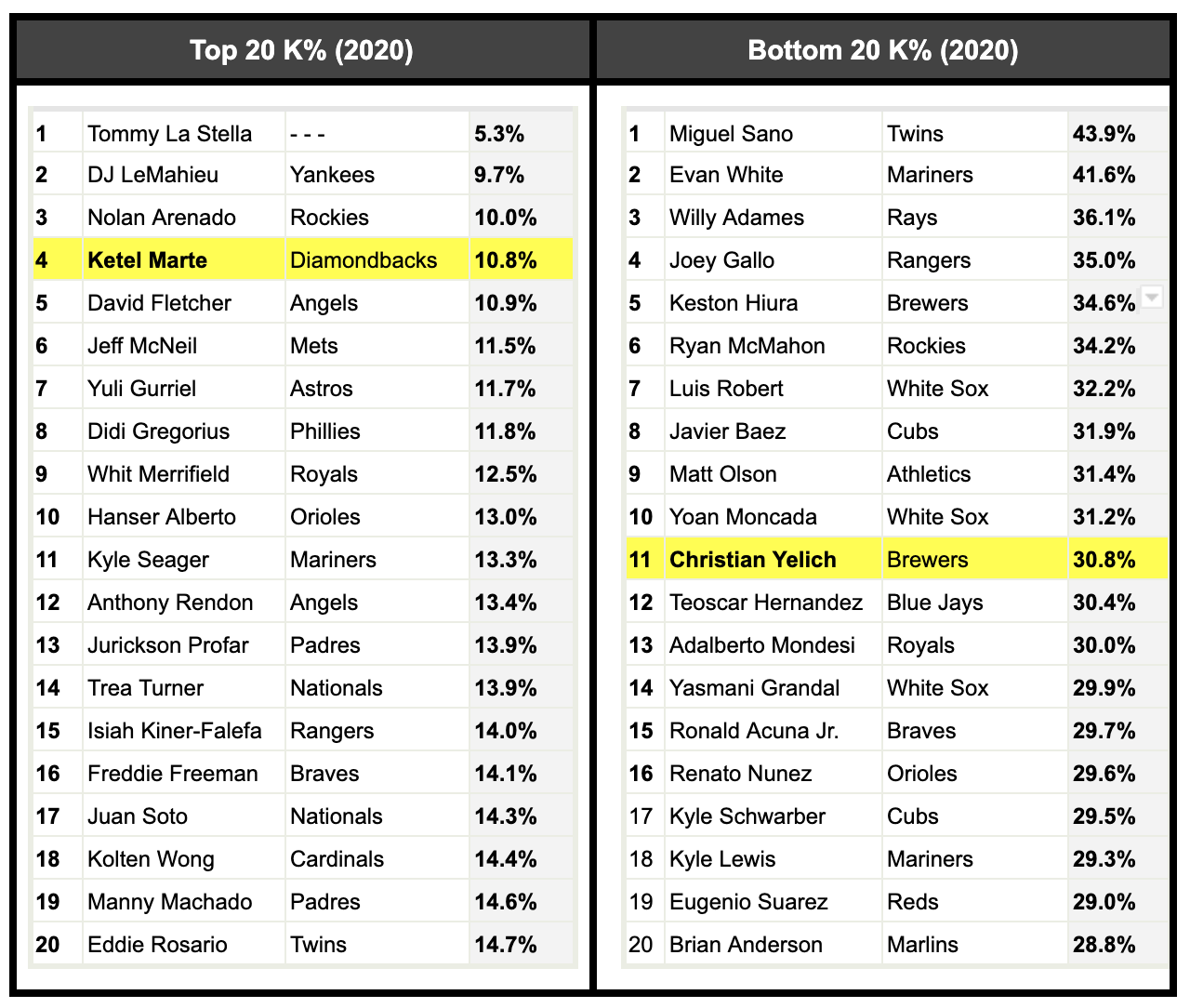
We can see some of the things we already know but in table form: Miguel Sano and Joey Gallo are strikeout machines, Nolan Arenado and DJ LeMahieu have excellent discipline and are much tougher to K.
You may also feel the impulse to use these leaderboards to look for players to target for your drafts or to try and understand an outlier performance in a small sample size (like the entire 2020 season). You might want to try and gauge whether players might bounce back or have developed a new skill (or problem). Two good examples include fantasy studs from the previous season, Ketel Marte and Christian Yelich.
It may be surprising to discover that Marte had a fantastic K% despite also having a down year or that Yelich, was suddenly in the 11th percentile. Weird, right? Rather than jump to a conclusion, it’s better to dig in and that means moving from basic things like K% to more meaningful numbers that can provide a better narrative. Let's start with Marte.
Digging In On Ketel Marte
With a 99th percentile strikeout rate of 10.8%, you might expect to be talking about how Marte had a successful 2020. However, we all know that Marte underwhelmed, not meeting his fantasy expectations and leaving a lot of managers who rostered him frustrated. When you realize that this was the lowest K% of his career, having dropped nearly 3% from 2019 in which his wRC+ was 150, it is only more puzzling. He should have been even better in 2020, right? But he was not (for those with the same natural curiosity as me, his wRC+ dropped to 95 in 2020 which means he went from being 50% better than the average player to 5% worse in one year). So what the heck happened?
For starters, his BB%, a handy companion to K%, plummeted, going from a scant 8.4% in 2019 to an abysmal 3.6% in 2020; this was the 3rd percentile. Yikes. There aren’t many hitters capable of success at the Major League level while walking less than 4% of the time regardless of the underlying skill sets. While this is likely part of the picture, it is still an output stat and it’s important to understand the difference between outcome-driven metrics and those that are more about input, the latter of which give us a much better sense of how “good” the player is at discrete skills that impact the outputs.
Let’s start with his HardHit% which was 40.5 in 2020 and 40 in 2019. That is a .5% increase which, while for all intents and purposes is the same as 2019, does nothing to help us understand the down year. In fact, if you take two of the three pieces of evidence that we have thus far, a 10.8% K% combined with a 40.5 HardHit%, you would still expect Marte to have had a killer year. This was a good rock to look under, but in this case, it doesn’t help much.
Let’s move on to exit velocity; not the average EV, however, but maxEV. Neither is perfect and here is why: the average EV is, like all averages, susceptible to outliers like an over-abundance of pop-ups, laser-show home runs, soft line drives, or worm-burners that are smoked directly into the ground. This is not ideal because it incorporates too many variables. MaxEV, on the other hand, is a single batted-ball event (BBE) so it isn’t affected by outliers, but it is also just a single data point which doesn’t tell us how repeatable it was throughout a season because it could be an outlier on its own; if a guy squared off on one and hit it significantly harder than all of the rest, his maxEV may look more enticing than his performance really was. The maxEV is still the better indicator but, unfortunately, in this case, the .4 mph dropoff (116.3 mph in 2019 to 115.9 mph in 2020) neither explains nor contributed to the issue.
Even if we split the difference with a little experiment and use EV/Barrel (average exit velocity of barrels), there was only a 2.4 mph decrease year-over-year which is still not significant enough to explain the downgraded performance. We press on.
The next two areas to examine are Barrel% and SweetSpot%. This really drills down into the quality of the hard-hit BBEs. Again, hard-hit balls driven directly into the ground are not useful and these will help us narrow down the effectiveness of his hard contact. Here are the past three seasons of data:
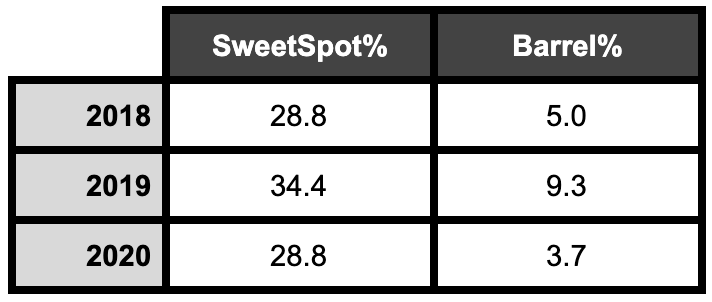
As you can see, there was a spike in the SweetSpot% in 2019. This likely doesn’t explain it all, but we are finally starting to see something that is likely a piece of the puzzle, especially when combined with the similar, but more significant, pattern in his Barrel%. 2019 seems to be a pretty significant outlier and here’s the thing about that: his career average is only 4.5% even when it is buoyed by 2019. His career average without it would be just 2.4. Something went really right in 2019 and this begs the question: was that the outlier and we should have seriously tempered expectations for Marte in 2021 or did he break out in 2019 and 2020 was a flukey, small sample size, chaotic and weird year that just so happened to come after that breakout and he’s more likely to look like 2019 than 2020 this coming year?
There is an answer, but it does depend on a couple of things. The first has to do with why he may have had a harder time squaring up the ball last year and it relates to count management and his low strikeout percentage. In this case, his 10.8 K% might be hurting him. Allow me to explain. Marte had a Whiff% in the 98th percentile due to a swinging-strike rate of just 5.6%. His overall swing percentage went down in 2020 as well, from 47.5% to 45%. And while it is not significantly different from previous seasons, his F-Strike%. This means that 6 out of 10 at-bats started 0-1. His low SwStr% also suggests that a majority of his strikes are called and he might be getting too cute with the strike zone and attacking the ball.
We haven’t talked a lot about wOBA here and now is a great time because it is going to tie together how being down in the count impacts production. It is a weighted on-base percentage metric that includes a valuation of the quality of the manner in which a hitter gets on base. For example, a walk is weighted differently than a double, triple, or home run such that the extra-base hits have more value. Admittedly, this is more of an output metric than input, but it does have value here. Furthermore, you may notice a familiar pattern over the last three seasons with Marte’s (for reference I have included his expected wOBA and expected wOBA on contact which focuses only on balls in play):

Once again we see that 2019 looks like the outlier just as it did with SweetSpot% and Barrel% which is good to have to support the validity of the wOBA numbers. And now it is time to add some data from a Fangraphs article from January 8, 2020, written by Ben Clemens entitled, The Count Is King (Even After Accounting for Batter Skill) that shows the impact of the count on the eventual outcome of an-bat. It is based on the wOBA that is produced after certain counts are established.
After the count goes 0-1, which we know happens to Marte on 60% of his at-bats, the league-side average wOBA produced is just .270. Conversely, the alternative, after having the count go 1-0, the wOBA is .363. This is very important. After the count goes 0-2 or 1-1, the wOBA produced is just .203 and .303 respectively. In 2019, Marte had a wOBA of .411 and the data shows that this is only achievable, on average, with counts of 2-0, 3-0, and 3-1.
It is now time to put the pieces together. Given that Marte’s 2020 wOBA was only .311 (and was expected to be even lower at .295), we can conclude that he needs to swing at the first pitch more often (because we know that most strikes against him are looking, not swinging). There are three reasons:
- He is being thrown strikes on the first pitch and if he watches them go by and starts at 0-1, he limits his wOBA potential by almost 100 points.
- To get to his wOBA from 2019, the numbers say he needs more counts of 2-0 and 3-0 and you can’t get there with a strike on the first pitch.
- Pitchers have no real reason to throw more balls on the first pitch until he starts swinging more and, once they have the first strike, get to feed the pitches they want rather than the pitches he can drive.
When you get down in the count, the pitcher is in the driver’s seat and the at-bat has to become somewhat defensive; even more so with two strikes. This limits the ability to drive the ball as consistently, which explains the inconsistencies with SweetSpot% and Barrel% too. This started with a natural curiosity about a guy with a stellar K% who had a bad year and now we have arrived at the conclusion that the answer may very well be that Marte needs to be willing to slightly increase his K% in order to be more effective at the plate in 2021.
Will Ketel Marte’s be more like 2020 or 2019 next year? As 2019 might very well turn out to be his career year, I would not expect him to return fully to that form. However, I think he can get more than halfway back to it if he does more damage on the first pitch and pushes the count advantage to his favor. If not, I would have severely tempered expectations.
Part 2 will continue with Christian Yelich, digging into his 2020 season starting with K%.
Download Our Free News & Alerts Mobile App
Like what you see? Download our updated fantasy baseball app for iPhone and Android with 24x7 player news, injury alerts, sleepers, prospects & more. All free!

More 2021 Fantasy Baseball Advice