RADIO
RADIO











Antonio Losada continues to explore the concept of volatility versus consistency in fantasy football. Should fantasy owners prefer more stable players or is the value relatively equal in the end?
If you have been following and reading the site lately, you know I started to explore the concept of "player volatility" in one of my last columns. That one definitely set the table for what is coming here and was already long enough for an introduction that I opted to split all of this content in multiple entries instead of putting it all in the same one. So here we are now back at it, to try and keep exploring what volatility can tell us about different players and how to best use it.
If you remember what I covered in the first entry, you already know that there is a more than strong relation between PPR and VOL (as we labeled "volatility", defined as the standard deviation of all PPR-scores a player logs weekly over the full season). The R-squared value between PPR and VOL going back to the 2000 season and up to the last one sits at 0.64 all-player-seasons considered.
Not that I need to make it much clearer, but that comes to say that players who tend to score more PPR/G are those with higher volatility tendencies on a fairly reasonable basis. Discussing this idea and the whole volatility concept with other analysts, a few questions related to it arisen. It's time to tackle them.
Bookmark our updated and revamped fantasy football rankings portal for all league formats!PPR rankings | Half-PPR rankings | Standard rankings | Rookie rankings | Superflex rankings | Dynasty rankings | Who To Start? | Injuries | Matchup Ratings | Strength of Schedule
How Stable Is Volatility From One Year To The Next?
This is one of the main questions to solve regarding volatility: are volatile players an actual thing, or is volatility just a random occurrence at certain points during any player's career? In order to answer it, we can look at how volatility changes from one year to the next one and try to find a relation between both values.
Before we tackle that question, though, it sounds fair to look at how the other main variable we are interested in--PPR fantasy points--correlates from one season to the next one. We would expect good players to keep their level over their careers, no matter how volatile they are in getting their fantasy tallies. Here is how PPR in Year N relates to PPR in Year N+1 (data from all players with at least a game played since 2000).

As expected, the R-squared yields a quite high 0.55 value in return when taking the full dataset into consideration (6,696 player-seasons). More than half of the PPR-points in Year N+1 are explained by the prior season tally, which is more than reasonable as more than half of the players considered posted similar seasons from one season to the next one.
Does something similar happen when looking at volatility, though? Do volatile players "stay volatile" from one year to the next one?

Truth be told, yes, they do. I know, I know. The relation is way lower when it comes to volatility compared to PPR, but the R-squared of 0.25 is high enough as to consider the relation from Year N to Year N+1 strong enough.
I have used the same scale in both charts above so you can compare the slope of the trend lines and realize how close they are. The data points are way more spread all across the scatter plot, but again, the 25% sounds more than good to make a serious case for volatility at something stable enough over time.
This year-to-year volatility relation (0.25) combined with the 0.65 r-squared between PPR and VOL should make volatility something to pursue when deciding between different players to put in our fantasy rosters. But that opens the door to the next question. Is that really true? Are volatile players actually more valuable than stable ones?
Should You Prefer Stable Or Volatile Players?
Call them safe or stable. Risky or volatile. It's the same, written differently. Back in the first column in which I defined volatility I used a clear example to show you how two players can achieve the same results taking very different paths to reach them. Let's use another one now to keep things fresh.

These are Aaron Rodgers' and Carson Wentz's 2019 weekly PPR scores. Rodgers was the "exciting" play, while Wentz remained "boring" for most of the year. When all was said and done, though, both players finished with pretty similar PPR/G averages: Rodgers at 20.4 and Wentz at 20.6, a disregardable difference. The way they arrived there, though, was very different.
Rodgers had four games over 30 PPR and four more under 13 PPR. Wentz, on the other hand, only had one game over 28 PPR and another one under 13 PPR, with the rest in between those marks. As happened with Amari Cooper and D.J. Moore in the first entry example, fantasy owners in need of points would have gone with Rodgers hooping for the explosion, while those needing just their weekly dose would have opted for Wentz's stability.
But in the long run, and working out of context, should fantasy owners pursue volatile or stable players? Here is how season-long PPR points (totals, not per-game averages) have correlated with VOL since 2000 (min. 10 games played in the season).

And broken down by position.

The overall relation drops just a bit here to an R-squared value of 0.61 (it was 0.65 for PPR/G) but mainly stayed the same. When split by position, though, there are some notable differences worth discussing:
- Quarterbacks have an R-squared PPR-VOL value of 0.20, the lowest among all positions.
- The running backs follow them with a relation of 0.63.
- Again, wide receivers and tight ends have the strongest relations at 0.68 for the WRs and a sky-high 0.75 for the TEs.
If there is a position calling for volatility when looking for the best potential season-long returns, that is tight end. Of the total 1,695 tight end-seasons in the data set (min. 10 games played), in 242 cases the player posted a VOL of 6.0 or greater. Of those 242 player-seasons, only 39 finished under 100 PPR over the year and the other 203 had an average of 11.5 PPR/G. For context, the average top-12 tight ends from 2000 to 2019 have averaged 11.3 PPR/G.
Don't get too caught into this, though. If there is a volatile position in football, it is definitely the tight end. Virtually no player, even the top-three players at the position, escape one or two horrific games during the season. Given that fantasy points have a defined floor of zero (not exactly true, as they can get into the negative side, but that's virtually impossible and doesn't happen very often) but no defined ceiling (at least in theory), players that have higher PPR scores will undoubtedly raise their averages while at the same time increasing their volatility marks.
The main takeaway, then, would be to seek tight ends with at least a chance at having some booming performances during the seasons, since we know that no matter what happens almost every tight end will sooner or later drop a goose egg.
Volatility In Historical Context
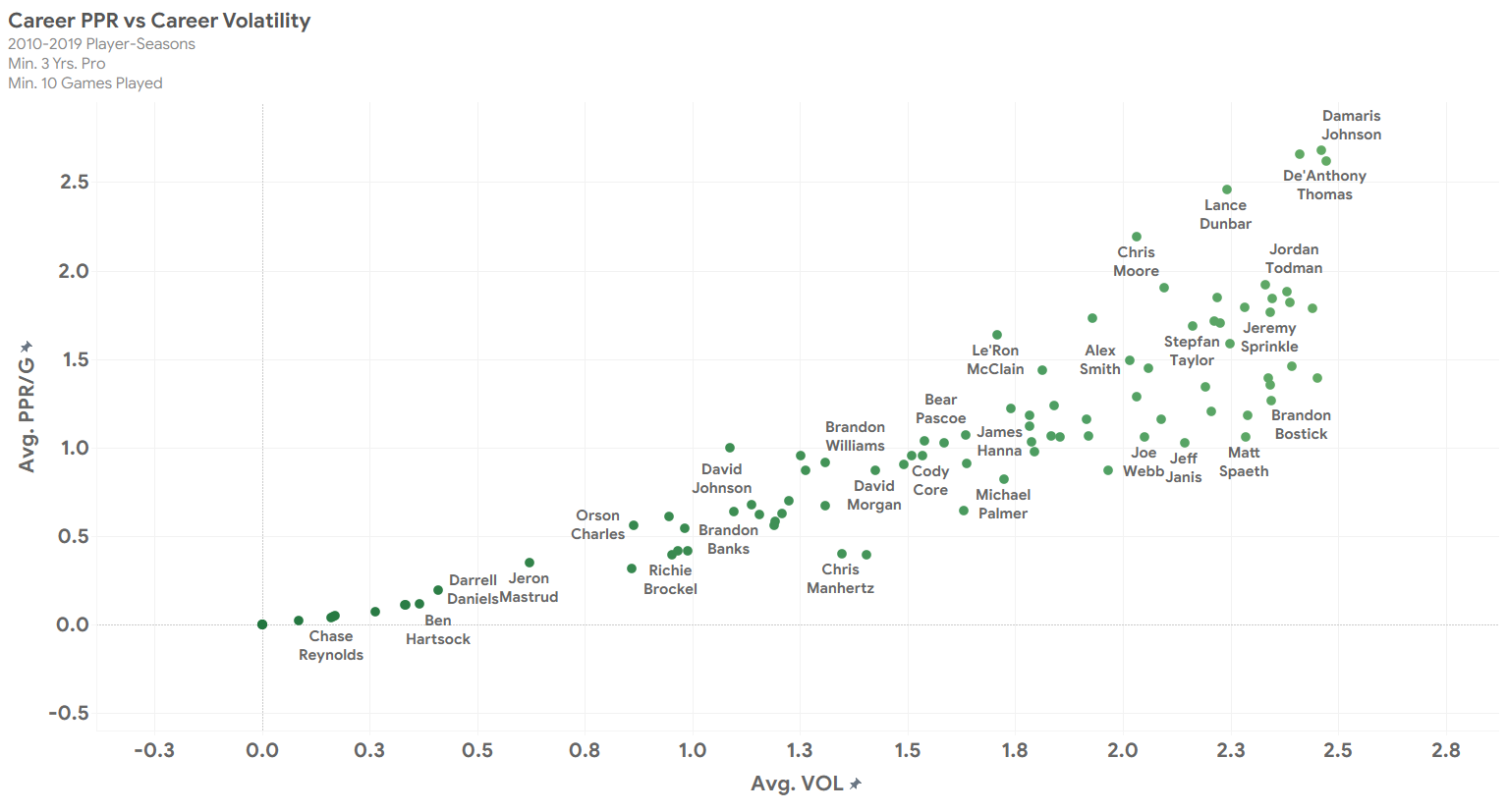
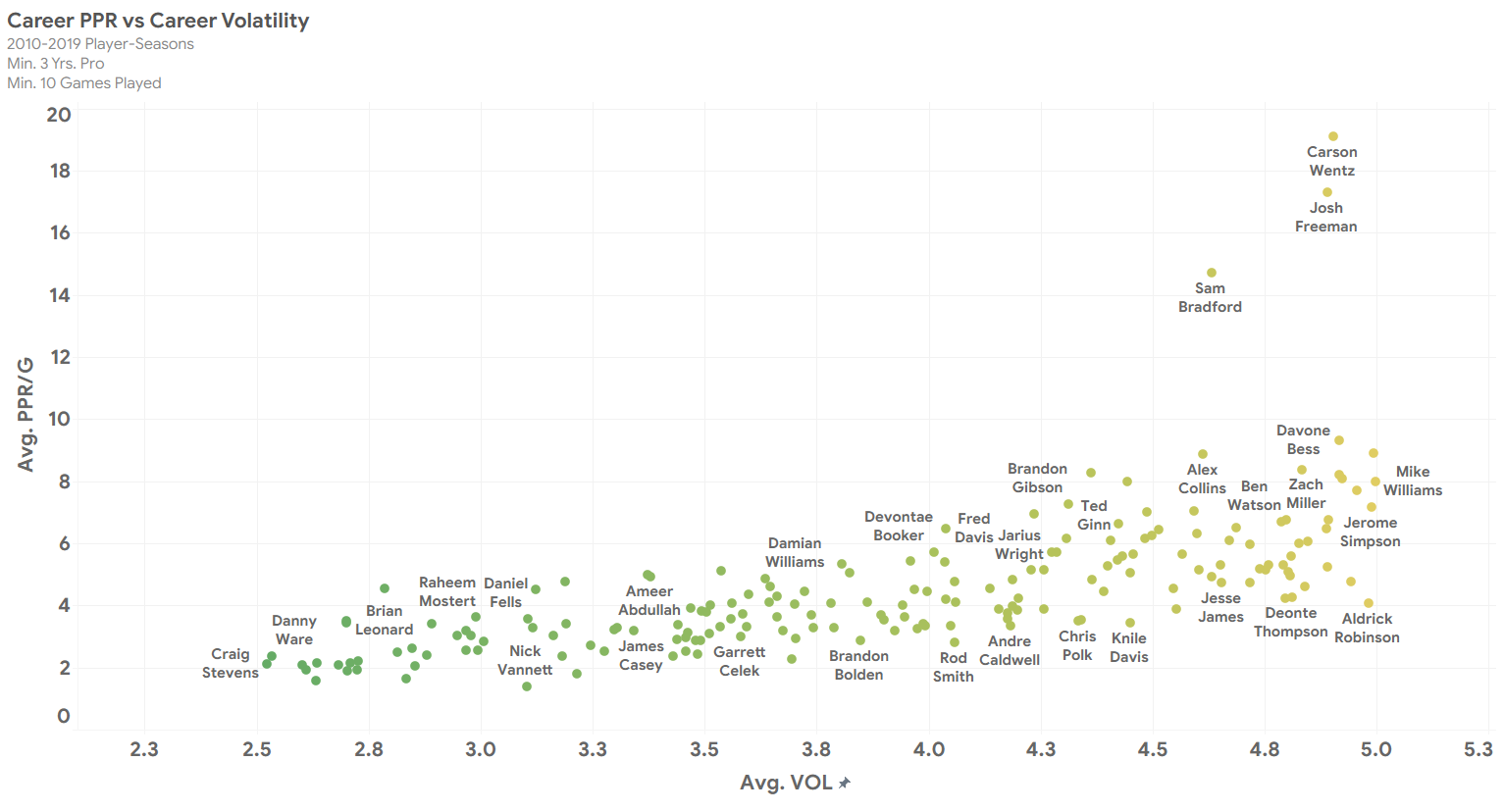
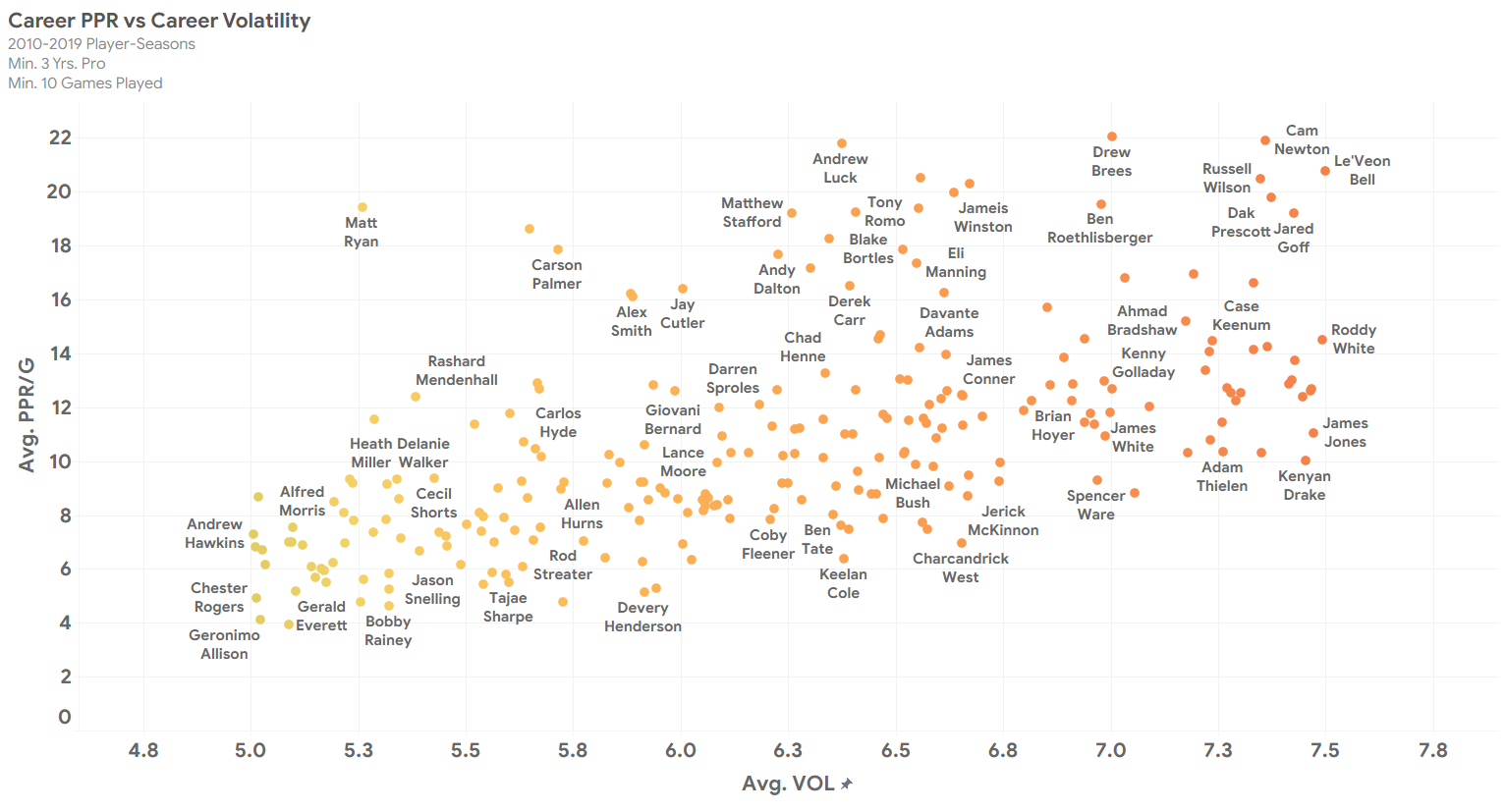
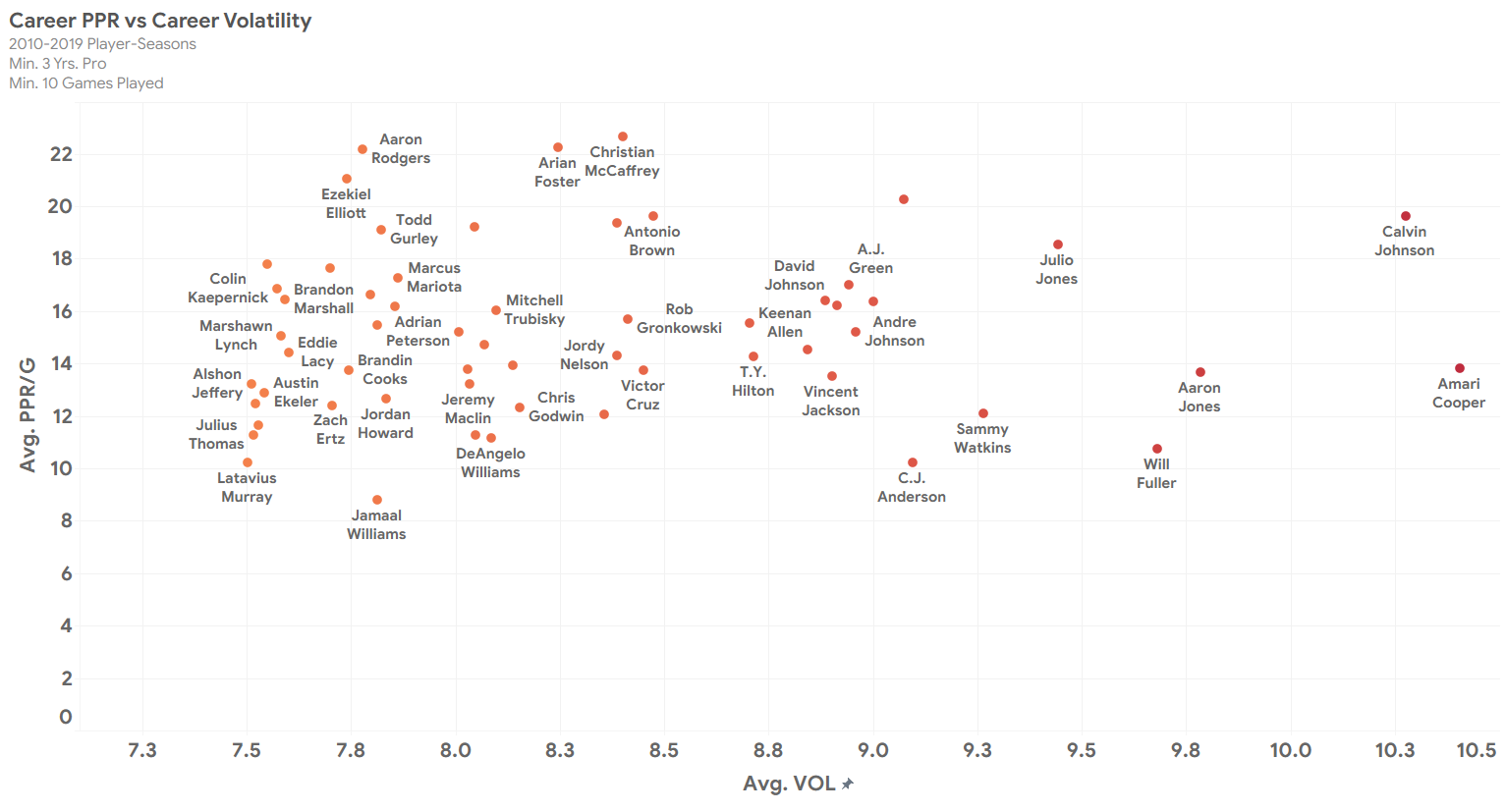
All of this is good, but to shed a little bit of light over the volatility concept and make it more understandable, I thought it'd be interesting to throw out some names so you know have a quick way to link different volatility levels to certain types of players.
I have trimmed the data set to just player-seasons from 2010 on with at least 10 games played and players with 3+ seasons of NFL experience. Here are a few charts with different ranges of VOL, from "safest" to "riskiest", including the names of some players so you can quickly relate those to their volatility and average PPR/G production. The colors mark how "stable" a player is in a diverging scale going from green (most stable) to red (most volatile).

click for full-screen view
More Fantasy Football Analysis