RADIO
RADIO









Interested in trying fantasy football? Interested in learning more about fantasy football? Josh Constantinou provides an overview of how to play fantasy football and what you need to know.
Whether you're reading this article because you are trying fantasy football for the first time or are interested in learning more about it, welcome aboard! It is one of the most exciting and entertaining activities that exist. It's also incredibly popular.
Fantasy sports is one of the fastest-growing industries in the world, especially in North America. In 2022, 62.5 million people played fantasy sports in the USA or Canada, according to the Fantasy Sports and Gaming Association. Of those, 60%, or 37.5 million, played NFL fantasy football.
This article will give you everything you need to start having fun and competing in all types of formats and settings.
Bookmark our updated and revamped fantasy football rankings portal for all league formats!PPR rankings | Half-PPR rankings | Standard rankings | Rookie rankings | Superflex rankings | Dynasty rankings | Who To Start? | Injuries | Matchup Ratings | Strength of Schedule
What is fantasy football?
Fantasy football is a game of probability based on real NFL game(s). It uses actual players playing at their official position to generate points from their statistical performances. It's also a fantastic way to live your dream of being a general manager by assembling a championship roster. You'll have the opportunity to draft the players you want most, make trades when you think one player or set of players is better than another, and acquire free agents to improve your team.
Plus, it makes watching football, which is already exciting, even more thrilling. You'll root for your specific players each, making you a fan of teams you never cared about or thought you would cheer for. Your knowledge of football, including the rules and strategy involved, will also grow exponentially. All while having fun with friends, family, coworkers, and complete strangers.
Positions
Just like on an NFL team, offensive and defensive players line up to face off against one another. The most prominent position is, of course, the quarterback, which will also be a staple of your team. The quarterback touches the ball on almost every play, making them very valuable because they have more opportunities to generate fantasy points. If the quarterback decides to pass the ball, they'll do so to either a wide receiver, tight end, or running back. All of whom can earn points by catching the ball and gaining yards.
In addition, players can score points by running the ball for yards, which is primarily the job of the running back but is a common feature of the quarterback and other positions. The ultimate payoff is when they find the end zone for a touchdown. It is the fastest way to rack up points. The other offensive player you'll encounter is a kicker, whose job is to convert field goals and extra point attempts, both of which count toward their total points.
There is one more category of offensive positions. It allows you to choose from multiple positions and is referred to as a "flex" position because there is flexibility in who you choose to fill that spot. It includes a wide receiver, running back, or tight end. Furthermore, the "superflex" position is increasingly popular, allowing you to choose from those three positions plus a quarterback.
On the other side of the ball is the defense. Most leagues will have one position that encompasses everything the defensive players on that team do to determine a final score. It's titled "DST" or "DEF." It requires you to select an NFL team, usually based on matchups or the overall quality of their players. The alternative is choosing defensive players from each position (cornerbacks, safeties, linebackers, defensive linemen) much like you would on offense, which is referred to as an IDP (individual defensive player) format. It definitely adds another layer of fun but can be more complicated when you are first learning, making it less common.
Scoring
Now that we've reviewed all the different positions, let's focus on the number of points they can score and how. As we mentioned above, the two ways to move the ball forward are passing or running, which along with receiving, are the three types of scoring categories. Let's start with passing.
Passing
The quarterback, who is almost always the one passing the ball, earns points based on how far the ball travels, also known as passing yards, along with passing touchdowns. The scoring setting for passing yards is one point for every 25 passing yards. For example, throwing for 250 yards would generate 10 points (250/25 = 10). Passing touchdowns are worth either four or six points, depending on the league or contest you're in. They can also lose points by throwing the ball to the other team, which is known as an interception. It causes them to lose two points from their total score.
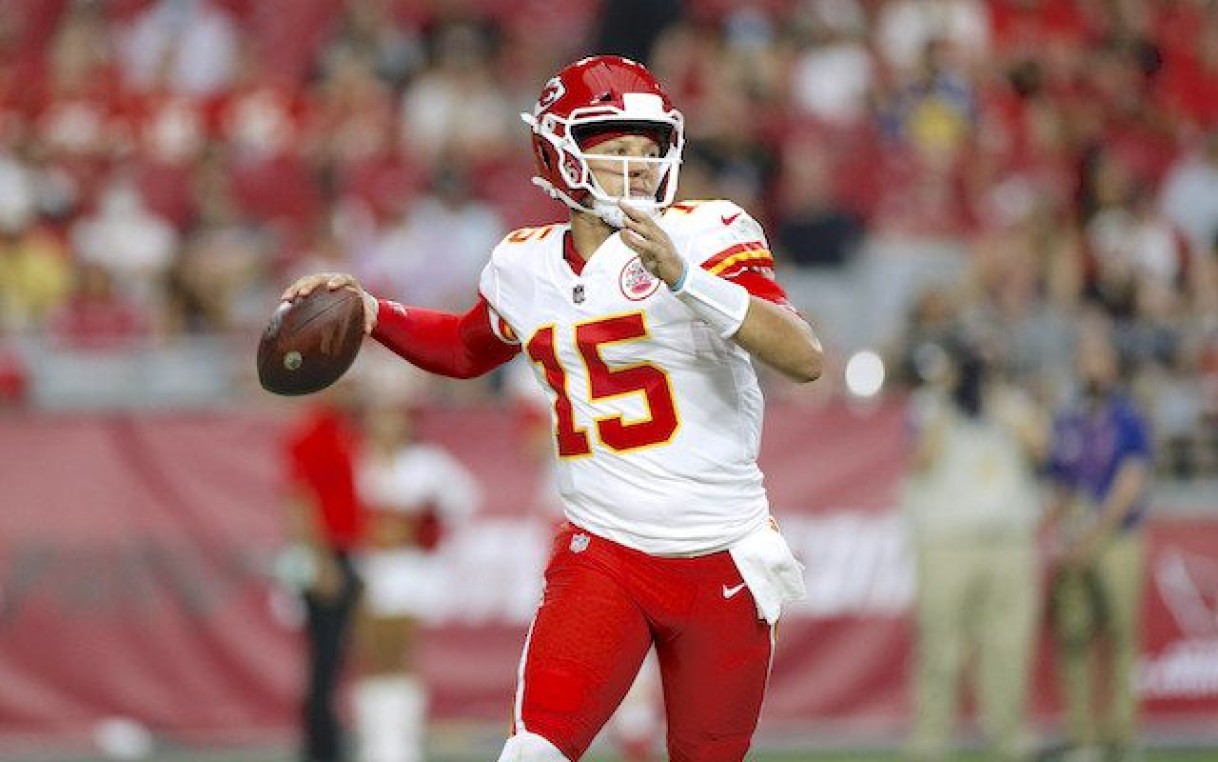
Let's examine the passing box score for Patrick Mahomes from the Super Bowl as a real-life example.
| Name | Completions/Attempts | Yards | Touchdowns |
| Patrick Mahomes | 21/27 | 182 | 3 |
Based on the formula above, his 182 yards are worth (182/25) 7.28 points and his three touchdowns are worth either (4x3) 12 or (6x3) 18 points, depending on the scoring, for a total of 19.28 or 25.28 points.
Receiving
Corresponding with the passing statistics are receiving statistics, which are applied to the player(s) who catch the ball, including wide receivers, tight ends, or running backs. They generate their points based on how far the ball travels, the number of touchdowns they score, and how many receptions they make. Receiving yards score as one point for every 10 yards. The amount of yards required is smaller because it's more difficult to generate receiving yards than passing yards. For example, 100 receiving yards would represent 10 points (100/10 = 10). Receiving touchdowns are worth six points. However, receptions can vary from counting as zero points, known as standard scoring, half a point for each reception, known as half-PPR (point per reception), or one point for each reception, known as full-PPR. Similar to quarterbacks, they can lose two points if they fumble the ball after they catch it and the other team recovers it.
Let's use another example from the Super Bowl. This time we'll examine superstar tight end Travis Kelce.
| Name | Receptions | Yards | Touchdowns |
| Travis Kelce | 6 | 81 | 1 |
Once again, using the formula above, his 81 yards would earn (81/10) 8.1 points, the touchdown is worth six, and the receptions would equal either (0 x 6) zero, (0.5 x 6) three, or (1 x 6) 6 points, depending on the scoring setting. Therefore, his total would be either 14.1, 17.1, or 20.1 points.
Rushing
The other way to move the ball is on the ground, resulting in rushing statistics. They usually come from the running back, but also the quarterback, or to a lesser extent, other positions. They are equivalent to receiving statistics where every 10 yards is worth one point, touchdowns are worth six, and a fumble causes them to lose two points. Some leagues also award points based on the number of rushing attempts a player has, but that's less common, so we'll leave that out of our calculations.
Let's stick with the Super Bowl theme here and use the Chiefs running back Isiah Pacheco.
| Name | Rushing Attempts | Yards | Touchdowns |
| Isiah Pacheco | 15 | 76 | 1 |
His yards are worth (76/10) 7.6 points and the touchdown is worth six, equaling a total of 13.6 points.
While Pacheco did not finish with any receptions in the Super Bowl, the lead back on the Eagles, Kenneth Gainwell, did, which is quite common. So let's calculate his total points accounting for both his rushing and receiving output.
| Name | Rushing Attempts | Yards | Touchdowns |
| Kenneth Gainwell | 7 | 21 | 0 |
On the ground, he ran for 21 yards and no touchdowns, worth 2.1 points.
| Name | Receptions | Yards | Touchdowns |
| Kenneth Gainwell | 4 | 20 | 0 |
Through the air, he finished with 20 receiving yards, worth two points, no touchdowns, and four receptions, worth either zero, two, or four points. Therefore, his total would be either 4.1, 6.1, or 8.1, depending on the scoring setting.
The final example we'll cover before we move to kickers and defense is a quarterback who threw and ran for yards. A specialty of Jalen Hurts from the Eagles. Here are his final numbers from the Super Bowl.
| Name | Completions/Attempts | Yards | Touchdowns |
| Jalen Hurts | 27/38 | 304 | 1 |
We'll do the passing first, 304 yards equals (304/25) 12.16 points and the touchdown is worth either four or six points.
| Name | Rushing Attempts | Yards | Touchdowns |
| Jalen Hurts | 15 | 70 | 3 |
*One fumble lost
As a runner, he added 70 yards for seven points and three touchdowns for 18 points. That gives him a total of (12.16 + 4 or 6 + 7 + 18) 41.16 or 43.16 points. The last thing to note here is that he lost a fumble, which takes away two points, leaving a final score of 39.16 or 41.16, depending on the scoring settings.
Kicking
Alright, let's cover kickers now. They earn one point every time they successfully make an extra point attempt, along with points for every field goal they convert based on how long it is. Fields goals are worth either three (39 yards or shorter), four (between 40 and 49 yards), or five (50 yards or longer) points. It's worth noting that some settings will deduct points for missed field goals or extra point attempts, but those are rarer, so again we'll exclude that from our calculations.
Let's use Harrison Butker from the Chiefs for this one.
| Name | FG | FG Attempted | XP | XP Attempted |
| Harrison Butker | 1 (27) | 2 | 5 | 5 |
Starting with the extra points, he successfully made five of them, worth five points. He also made one field goal, which happened to be from 27 yards away, earning him three (39 yards or less) more points for a total of eight. The NFL box scores don't always include the distance of the field goal, but your fantasy platform will.
Defense
Lastly, we have the defense. As discussed under positions, you select one team that you are confident will limit the opposing offense to a lower point total while also creating turnovers, getting sacks, blocking kicks, and scoring defensive touchdowns. A turnover, which is an interception or fumble committed by the other team, is worth two points. Sacks, which is when the defense tackles the quarterback for a loss of yards while he still has the ball, is worth one point. Blocking a kick, including a field goal or punt, is worth two points. Lastly, defensive touchdowns, just like offensive ones, are worth six.
Some leagues or contests will only score based on these factors, but many will also adjust the total depending on how many points they allowed the other team to score, outlined below.
| Points Allowed | Fantasy Points |
| 0 | 10 |
| 1-6 | 7 |
| 7-13 | 4 |
| 14-20 | 1 |
| 21-27 | 0 |
| 28-34 | -1 |
| 35+ | -4 |
Let's do one example here based on the Chiefs defense in the Super Bowl.
| Team | Turnovers | Sacks | Blocked Kicks | Touchdowns | Points Allowed |
| Chiefs | 1 | 2 | 0 | 1 | 35 |
Starting with turnovers there was one, worth two points, two sacks, also worth two points, one touchdown, worth six points, and 35 points allowed, causing them to lose four points. That makes for a total of (2 + 2 + 6 - 4) six points. Once again the box scores aren't always ideal for determining this, but your fantasy platform will do the work for you, listing each factor.
Drafting
Now that we know the positions you have to choose from, the next activity will be assembling your roster. Generally, the way that occurs is through a draft, with the exception of Daily Fantasy Sports (DFS), which we'll talk more about shortly. Drafting is arguably the greatest part of fantasy football, aside from maybe winning a championship. It's so popular that there are formats where essentially all you do is draft, referred to as "best ball," which we'll also discuss later.
The draft process mimics the NFL, where there is a pool of players available, and each team selects someone to join their team one by one until their roster is full. There are two types of drafts that occur, differing based on how many players you can choose from. Typically you complete a full draft where everyone is up for grabs, enabling the first team to choose whoever they like, then the second team can choose anyone but the player taken first, and so on. It is repeated round by round until every team has the maximum amount of players required. The other type is a rookie-only draft, where you choose from players joining the NFL from college to add those players to the ones you already have. These occur in dynasty leagues, which will be explained soon. Many leagues will also allow you to trade draft picks for players and/or picks as another way to increase flexibility and fun.
There are a ton of different draft strategies, which you can learn more about from the RotobBaller team, but the most important tips when you are first learning are to be prepared and flexible. It really helps to know which players you like relative to other ones and to track them as the draft progresses. Similarly, it's best to be ready for unexpected picks, requiring you to stray from your initial game plan. Mock drafts, which are drafts on your platform with automated/computerized players, are a great way to practice. Another tip is to familiarize yourself with the settings beforehand as many leagues and contests will have different rules.
Start/Sit Decisions
Once you've filled your roster, you can begin your preparations for Week 1. One of the biggest challenges fantasy managers face each week is deciding which players they want to start and which ones they want to leave on the bench. Every league will dictate the number of players you use to generate your total each week, also known as your starters, while the rest are excluded, referred to as left on your bench. There are a bunch of great resources here at RotoBaller throughout the season for this that I would encourage you to utilize. For now, the best advice would be to start your best players, the ones who were drafted highly and are projected to score the most and to consider the matchup they have. When a great player has a tough matchup against a highly-ranked defense, it is worth exploring other options, primarily players who score fewer points but have a better matchup. I recommend joining our Discord channel to take advantage of our panel of experts each week.
Transactions
Most leagues allow you to make changes to your team throughout the season, which are referred to as transactions. These include making trades with the other people in your league, adding free agents who are not on anyone's team, and dropping players you no longer want on your roster. There's an art to all three of these, and again lots of resources from our crew to help you succeed, but the best tip here is to be willing to make moves even if they don't always work out. Every transaction involves a level of risk because it could turn out poorly. However, it also possesses a level of reward because it could make the difference between winning or losing your league. You should never feel forced to make a move, but always be open to improving your squad.
Formats
There are constantly new and innovative formats in the fantasy football world, many of which are variations of the originals. We'll cover the mainstream options here. The first one is managed leagues that include a draft and transactions. These can vary in terms of scoring settings and positions as well as the number of players you can draft, ranging from all of them in a redraft format to all except a few that each team keeps in a keeper format to only the rookies in a dynasty draft. Dynasty leagues are unique because you can keep almost all your players from year to year, adding in rookies and making trades with your league members to construct a championship winner. They also allow for more activity in the offseason, keeping you involved while the NFL is on hiatus.
The second is best ball leagues, which include a draft but do not include transactions. They can also vary in terms of scoring settings and positions. Additionally, the players you start are automatically set each week after the games are finished, based on who were the highest-scoring players, providing you with the optimal lineup. It places all the emphasis on the draft, removing the ability for you to make changes to your team throughout the season, making it easier to play in multiple leagues in terms of time commitment.
The third is Daily Fantasy Sports, which features contests that start and finish that same week, often that same day. They do not include a draft, allowing you to have access to every player every week instead of whoever is on your roster. It's a new opportunity to win each week regardless of the team you constructed the week before, removing the impact of your past decisions.
The final note here is tournament-style formats, which include hundreds, sometimes even thousands, of teams competing against one another for a grand prize. These will feature aspects of all the other formats. The difference is that teams play against one another to knock their opponent out of competition and advance to the next round of the tournament. They can be shorter, lasting only a few weeks, or longer, lasting the entire season, but are always a great way to put your skills to the test.
Each format allows you to win a title and earn bragging rights and/or money. They are also a lot of fun, and a fantastic way to enjoy fantasy football.
Conclusion
Fantasy football is an exciting and growing industry with tons of brilliant analysts, many of which are right here at RotoBaller. There are lots of resources and tools you can use for every format, so get involved, have fun, and win a title or two while you are at it.
Download Our Free News & Alerts Mobile App
Like what you see? Download our updated fantasy football app for iPhone and Android with 24x7 player news, injury alerts, rankings, starts/sits & more. All free!

More Fantasy Football Analysis